
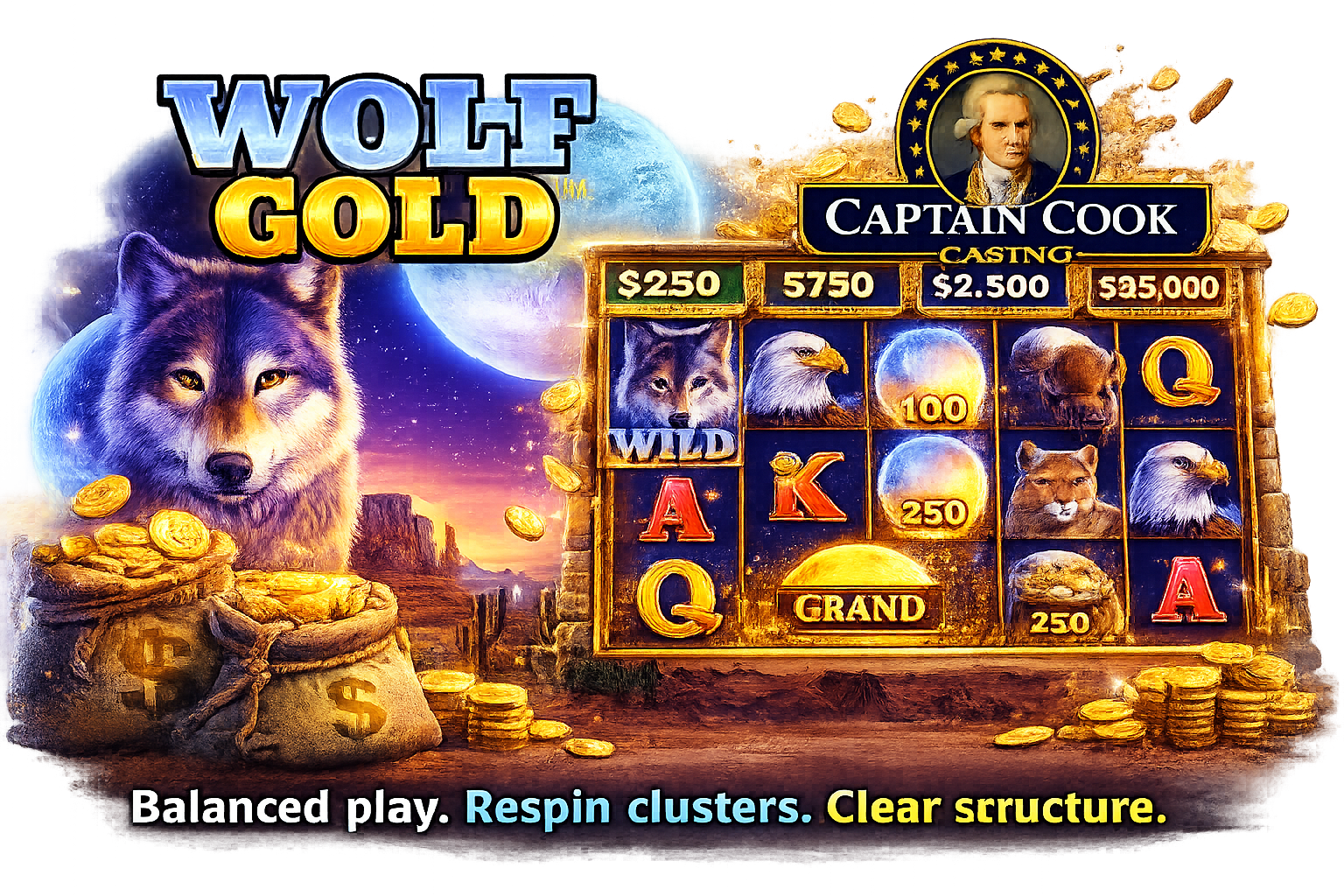
Wolf Gold — core structure and interaction model
Wolf Gold is built around a hybrid structure that combines a stable base game with a clearly defined feature trigger system. Unlike cascade-driven slots or purely feature-dependent models, it maintains a more balanced interaction profile, where both the base game and the feature layer contribute to the overall session experience.
The base game is active and readable, but it does not attempt to create extended internal chains. Instead, it provides consistent low-to-mid level interaction while the player moves toward feature triggers. The key difference from high-volatility feature slots is that the base layer here still carries meaningful participation in the session, even though the highest-impact events remain tied to specific mechanics.
This creates a more even session structure compared to games like Big Bass Bonanza, while still allowing for concentrated outcomes when features activate.
RTP as a distributed long-term model
RTP in Wolf Gold is distributed across both the base game and feature layer, rather than being heavily concentrated in a single mechanic. This makes the game feel more balanced across sessions, even though it still includes high-impact elements such as jackpots.
However, RTP remains a long-term statistical model.
Short sessions:
- may not include feature activation
- may not reflect jackpot mechanics
- may show only base-level interaction
This does not indicate deviation from RTP. It reflects how distribution is structured. Wolf Gold spreads its value more evenly than feature-heavy slots, but still relies on specific triggers for higher-impact outcomes.
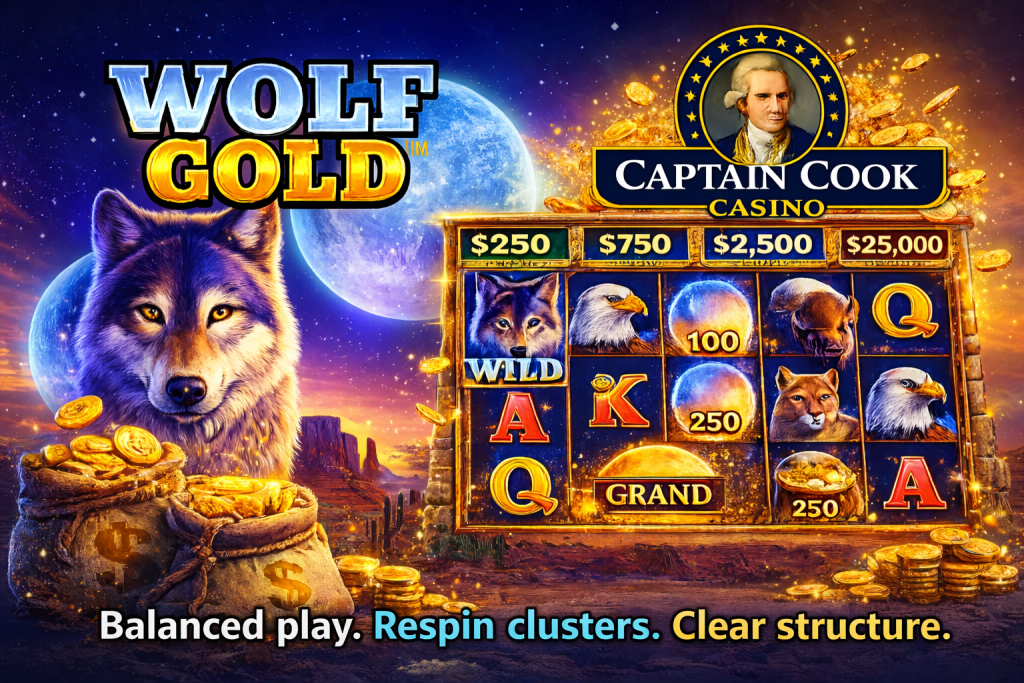
RNG behaviour and independence
The RNG in Wolf Gold operates independently on every spin.
There is:
- no progression system
- no probability increase over time
- no accumulation of trigger likelihood
The Money Respin feature, as well as jackpot events, are not influenced by previous outcomes. Even though the visual design may suggest buildup (e.g., scatter appearance), each spin is generated without reference to prior results.
This ensures structural clarity:
- outcomes are independent
- patterns are not predictive
- sequences do not carry forward
Volatility — hybrid distribution model
Wolf Gold sits in a medium-to-high volatility range, but unlike strongly feature-dependent slots, its volatility is distributed across multiple layers.
Base game:
- frequent moderate interactions
Feature layer:
- higher intensity events
- jackpot potential
This creates a mixed profile:
- more stable than Big Bass Bonanza
- less continuous than Gonzo’s Quest
The player experiences both:
- ongoing engagement
- occasional spikes
This balance is central to the game’s positioning.
Core mechanic — stacked wilds and expanding symbols
The base game relies on expanding wilds and stacked symbol behaviour.
These mechanics:
- increase hit visibility
- support medium-frequency wins
- maintain engagement without relying on feature triggers
They do not create cascading chains or internal progression, but they add structure to the base layer. This helps prevent the session from feeling empty during non-feature phases.
Feature structure — Money Respin and jackpots
The main feature is the Money Respin system.
When activated:
- special symbols lock in place
- respins continue until no new symbols appear
- jackpots can be triggered (Mini, Minor, Major, Grand)
This creates a contained feature loop:
- entry → symbol collection
- continuation → respin extension
- resolution → payout
The feature is discrete and isolated, but more layered than simple free spins.
Session behaviour — mixed rhythm profile
Sessions in Wolf Gold tend to follow a mixed rhythm:
- base → steady interaction
- build → scatter appearance
- trigger → feature activation
- spike → respin/jackpot phase
- reset → return to base
Unlike Big Bass Bonanza, the base game remains relevant throughout the session.
Unlike Gonzo’s Quest, interaction does not remain continuous inside spins.
The result is a middle-ground structure that combines stability with intermittent intensity.
Analytical mechanics table
Wolf Gold — feature structure and jackpot mechanics
Wolf Gold introduces a different type of feature logic compared to both cascade-driven slots and purely bonus-dependent models. Instead of relying on long sequences or extended feature rounds, it uses a contained respin mechanic that creates short, concentrated interaction clusters. The Money Respin feature activates when special symbols appear, locking them in place and triggering a sequence of respins where additional symbols can extend the event. This creates a localized interaction loop where the entire focus shifts from standard gameplay to symbol accumulation within a fixed space.
The key distinction here is containment. Unlike free spins systems that unfold across multiple rounds with evolving structure, the respin feature operates inside a compressed window. The player sees immediate engagement, immediate escalation potential, and immediate resolution. This gives the feature a more “instant” character, where intensity appears quickly and resolves without long buildup. From a structural perspective, this reduces the waiting time between trigger and engagement compared to feature models that require multiple steps to develop.
Jackpot integration and value concentration
The jackpot system is integrated directly into the respin feature rather than existing as a separate or progressive layer that evolves over time. Each jackpot tier—Mini, Minor, Major, and Grand—is tied to symbol combinations within the respin grid. This means that jackpot outcomes are not accumulated gradually, but instead exist as discrete events inside the feature window. When the correct configuration appears, the outcome resolves immediately, without carryover or continuation beyond the current event.
This creates a distinct type of value concentration. Unlike progressive jackpot systems that build over time or bonus ladders that extend across multiple triggers, Wolf Gold places its highest-impact outcomes inside short, isolated sequences. The player does not move toward a jackpot through progression. The jackpot exists as a conditional outcome within a single activated feature. This reinforces the idea that each event is independent and self-contained, even when it produces a high-value result.
Feature frequency and session perception
Because the Money Respin feature is not extremely rare compared to full bonus rounds in other slots, the game maintains a more active session profile. The player is more likely to encounter feature activation within a moderate session length, which reduces the sense of extended inactivity. However, this does not mean that high-value outcomes are frequent. The feature itself may appear with some regularity, but the distribution of outcomes within that feature remains uneven.
This creates a layered perception. The session feels active because features appear, but the actual value distribution still depends on how those features resolve. Some respin sequences may end quickly with limited impact, while others extend and produce more substantial results. This distinction is important, because it separates feature frequency from outcome intensity. The presence of a feature does not guarantee a meaningful outcome, and the system does not attempt to smooth this variability.
No progression between features
Each respin event in Wolf Gold is fully independent from the previous one. There is no accumulation of symbols, no persistence of state, and no progression system that carries forward from one feature to the next. Once the respin sequence ends, the game returns to its base state, and the next feature—if triggered—begins from zero. This ensures that the system remains clean and predictable in structure, even if the outcomes themselves vary significantly.
This lack of persistence simplifies interpretation. The player does not need to track hidden variables or anticipate future states based on past events. Every feature is a standalone interaction, and every outcome is resolved within its own boundaries. From an operator perspective, this reduces ambiguity and reinforces transparency, as the system does not imply any form of buildup or delayed reward mechanism.
Session structure — cluster-based intensity model
The overall session structure in Wolf Gold can be described as cluster-based rather than continuous or spike-only. The base game provides a steady interaction layer, while features appear as compact clusters of increased intensity. These clusters are not as abrupt as the spikes in highly volatile feature slots, but they are also not integrated into a continuous flow like cascade systems. Instead, they sit between these two models, creating a rhythm that alternates between stability and short bursts of focused interaction.
This structure gives the game a balanced pacing profile. The player is not locked into long waiting periods, nor are they constantly engaged in evolving sequences. Instead, the session moves through cycles of steady play and contained feature events. This makes the experience more predictable in structure, even though individual outcomes remain variable.
Wolf Gold — session structure model
Wolf Gold — session structure
This model illustrates steady base interaction with clustered feature activation. It does not represent RTP or predict outcomes.
Base layer
Stable interaction with moderate engagement across spins.
Feature clusters
Short, concentrated respin events with jackpot potential.
No carryover
Each feature resolves independently without persistence.
Interface behaviour, pacing, and cross-device readability
Wolf Gold maintains a more balanced visual and interaction profile compared to both cascade-driven slots and strongly feature-dependent models, and this becomes especially clear when viewed across different devices. The interface does not rely on constant motion to sustain attention, nor does it fall into extended inactivity between key events. Instead, it presents a steady visual baseline through the base game, where expanding wilds and symbol alignment create enough movement to maintain engagement without overwhelming the player with layered mechanics or rapid transitions.
On mobile devices, this balance becomes particularly valuable. The screen space is limited, and games that depend on complex, multi-layered interactions often lose clarity when compressed. Wolf Gold avoids this issue by keeping its primary elements visible and easy to interpret. The player can quickly identify outcomes, understand symbol behaviour, and follow the transition into the respin feature without needing to track hidden states or multiple overlapping systems. This makes the game more resilient in interrupted sessions, where attention shifts and quick re-entry are common.
Session pacing and perceived continuity
The pacing of Wolf Gold sits between continuous flow and segmented interaction, which gives it a more neutral rhythm across sessions. Unlike Big Bass Bonanza, where long waiting phases define the experience, Wolf Gold maintains a sense of ongoing participation even during non-feature spins. The base game produces enough activity to keep the session moving, while still leaving room for feature-triggered intensity.
This creates a perception of continuity without actual structural persistence. The player feels engaged across the session, but the system itself remains reset-driven. Each spin is independent, and each feature is isolated, yet the visual and interaction layers create a smoother overall experience. This distinction is important, because it explains why the game can feel stable even when outcomes vary significantly across short sessions.
Desktop interpretation and visual spacing
On desktop, the game benefits from additional space that enhances readability and reduces perceived compression. The reel area becomes easier to scan, symbol alignment is more visible, and feature transitions appear more controlled. The respin feature, in particular, gains clarity because locked symbols and jackpot indicators are easier to distinguish within a larger frame. This improves the player’s ability to interpret what is happening during high-intensity moments.
However, this does not change the underlying mechanics. The same cluster-based feature logic applies, and the same reset behaviour defines the session. The difference lies purely in presentation. Desktop environments make the structure feel more open and less constrained, which can subtly influence how the pacing is perceived, even though the mathematical model remains unchanged.
Interaction flow and user experience
The interaction flow in Wolf Gold is structured but not rigid. The player moves through a repeating cycle of base interaction and feature activation, but without the abrupt transitions seen in more segmented games. The base game provides continuity, while the respin feature introduces temporary concentration of activity. These phases connect more smoothly, creating a session that feels cohesive without relying on continuous internal mechanics.
This makes the game more accessible across different play styles. Players who prefer steady interaction can rely on the base game, while those looking for higher-intensity moments can engage with the feature layer. The system does not force a single rhythm but instead allows both elements to coexist within the same session. From an operator perspective, this flexibility improves usability and reduces friction, as the player is not required to adapt to a single dominant interaction model.
Analytical environment table
Wolf Gold — positioning within slot design models
Wolf Gold occupies a middle position between continuous-mechanic slots and feature-dominant systems, and that positioning is not accidental. It is designed to avoid the extremes of both models by maintaining a stable base layer while still providing access to concentrated, high-impact events through its respin and jackpot mechanics. This allows the game to deliver a session that feels active without becoming structurally dependent on rare triggers, while still preserving the potential for intensity when the feature activates.
In practical terms, this means the player is rarely in a completely passive state. The base game continues to produce visible outcomes through expanding wilds and symbol alignment, which gives the session a sense of continuity. At the same time, the feature layer introduces moments where the structure tightens and interaction becomes more focused. This dual-layer approach creates a more balanced experience compared to slots that rely entirely on either continuous flow or isolated spikes.
Volatility vs perceived activity
One of the key distinctions in Wolf Gold is the difference between how volatility is structured and how the session feels moment-to-moment. The game can appear active because the base layer produces regular interaction, but this should not be confused with reduced volatility. The higher-impact outcomes remain tied to the respin feature and jackpot mechanics, which means that a significant portion of value is still concentrated in specific events rather than evenly distributed.
This creates a subtle dynamic. The player experiences steady engagement, but the statistical weight of outcomes is not evenly spread across all spins. Instead, the base game provides continuity while the feature layer carries a disproportionate share of value. This separation allows the session to feel stable without altering the underlying distribution model. From an operator perspective, this is an important clarification, because it prevents the misinterpretation that frequent interaction implies lower risk.
RTP interpretation and session limits
RTP in Wolf Gold is easier to perceive than in heavily feature-dependent slots, but it still cannot be meaningfully evaluated within short sessions. Because the game distributes value across both base and feature layers, players may observe more consistent returns during regular play, yet the absence of feature activation can still lead to sessions that diverge from the theoretical model. Similarly, a single feature event may produce a result that significantly exceeds or falls below expectation.
This reinforces the need to treat RTP as an aggregate measure rather than a short-term indicator. The presence of steady base interaction can make the session feel more predictable, but the actual outcome distribution remains dependent on the occurrence and resolution of feature events. The system does not smooth or adjust outcomes to align with short-term expectations. It remains consistent only at scale.
Demo mode and system visibility
Demo mode in Wolf Gold provides a clear view of how the system operates without introducing predictive value. It allows the player to observe how respin features activate, how symbol locking works, and how jackpot conditions are formed within the grid. This makes it easier to understand the structure of the game, particularly the relationship between base play and feature activation.
However, the outcomes observed in demo mode should not be interpreted as indicative of future results. The RNG remains independent and memoryless, and the same distribution rules apply regardless of whether the game is played in demo or real mode. What demo mode offers is transparency of mechanics, not insight into probability. This distinction is essential for maintaining accurate expectations.
Player fit and session preference
Wolf Gold is well suited to players who prefer a balanced session profile, where engagement is maintained without relying entirely on feature triggers. It offers enough base-level interaction to avoid long inactive periods, while still providing access to higher-intensity events through its respin system. This makes it a practical choice for players who want a more stable experience without removing the possibility of larger outcomes.
At the same time, it may be less appealing to players who are specifically looking for either continuous, evolving interaction or highly concentrated, high-volatility spikes. Those preferences are better served by cascade-driven slots or strongly feature-dependent designs. Wolf Gold does not attempt to dominate either category. Instead, it maintains a controlled balance between the two, allowing for a more measured session flow.
Structural clarity and operator framing
From an operator perspective, Wolf Gold is straightforward to present because its structure is transparent and easy to explain. The player can clearly distinguish between base interaction and feature activation, and there are no hidden progression systems or ambiguous transitions between states. Each spin is independent, each feature is self-contained, and each outcome resolves within its own defined boundary.
This clarity reduces friction and supports trust in the system. The game does not rely on implied progression or hidden mechanics to create engagement. Instead, it presents a clean structure where the rules are visible and the interaction is consistent. That makes it easier to position within a portfolio, particularly for players who value predictability in structure, even when outcomes remain variable.