
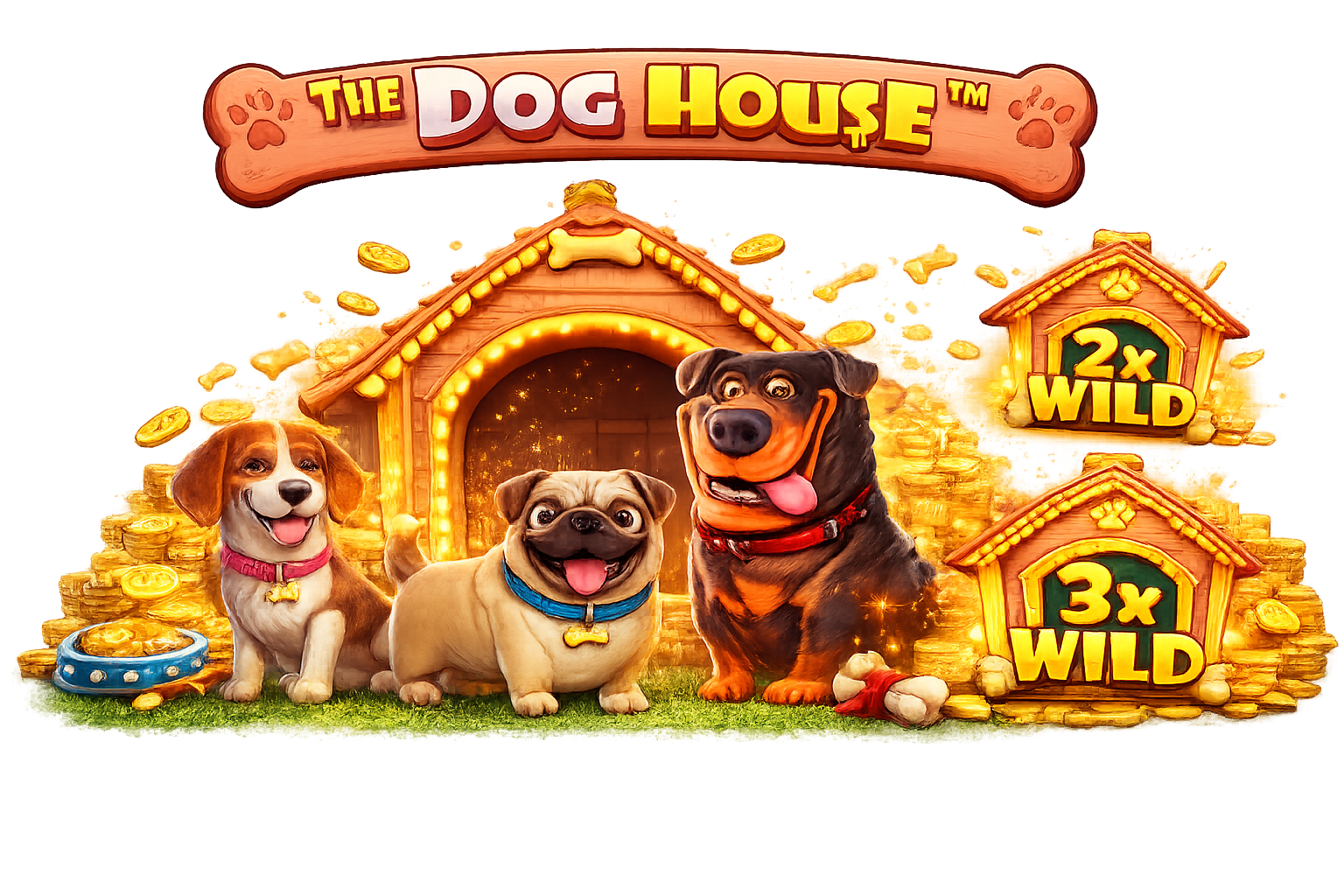
The Dog House — core structure and interaction model
The Dog House is built around a feature-led structure where the majority of meaningful interaction occurs during the free spins phase, supported by a base game that remains active but structurally limited. Unlike cascade-based slots, the game does not develop interaction inside a single spin. Instead, it creates its identity through a transition from a stable base layer into a more complex and persistent feature environment.
The base game operates as an entry layer. It provides regular outcomes through standard reel alignment and occasional wild placement, but it does not carry long-form interaction or progression. There are no expanding chains or evolving sequences within individual spins. The structure remains discrete, with each spin resolving independently before the next begins.
The defining shift occurs when the feature is triggered.
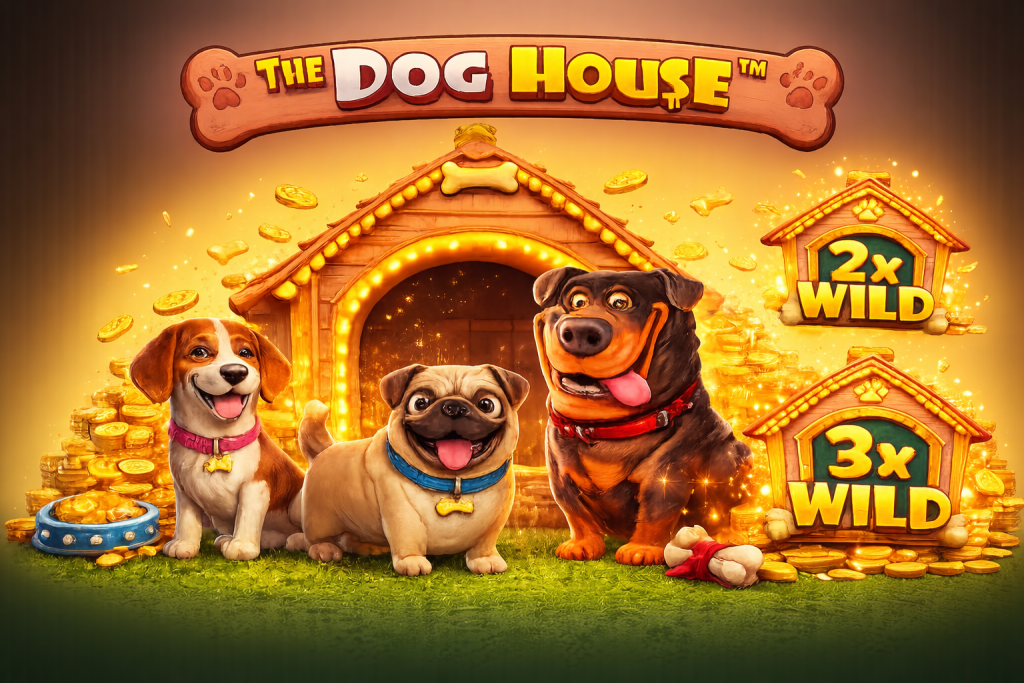
RTP as a feature-weighted model
RTP in The Dog House is distributed unevenly, with a significant portion of the theoretical return allocated to the free spins feature. This means that the base game alone does not represent the full statistical model, and short sessions that do not include feature activation may appear disconnected from the expected return.
This distribution is structural.
The game is designed so that:
- base gameplay maintains continuity
- feature gameplay carries intensity
As a result, RTP becomes more visible only when both layers are experienced over a larger number of spins. The base game provides stability, but the feature defines variation.
RNG behaviour and independence
The RNG governs each spin independently, including both base game outcomes and feature triggers.
There is:
- no buildup toward free spins
- no adjustment after losses
- no dependency between spins
Even though scatter symbols visually suggest progression toward a feature, this is not how the system operates. Each spin has the same probability of triggering free spins regardless of previous results. This maintains a memoryless system where outcomes are not influenced by session history.
Volatility — feature-driven with internal persistence
The Dog House sits in a high volatility range, but the nature of that volatility differs from both jackpot-based and cascade-based slots. Instead of concentrating value into extremely rare events or distributing it across continuous chains, the game builds volatility inside the feature through persistence.
Sticky wilds with multipliers remain active across multiple spins within the free spins round. This creates a structure where:
- intensity increases over time inside the feature
- outcomes depend on how the feature develops
The volatility is therefore expressed through feature progression rather than isolated spikes.
Core mechanic — sticky wild multipliers
The central mechanic of The Dog House is the sticky wild system during free spins.
When activated:
- wild symbols land with multipliers
- they remain fixed for multiple spins
- additional wilds can accumulate
This creates a compounding effect within the feature. Each new wild increases the potential of subsequent spins, which leads to a progressive buildup of interaction. Unlike base game mechanics, this system introduces persistence across multiple spins within the same feature window.
Feature structure — discrete entry, progressive build
The feature structure is divided into two clear phases:
- trigger → free spins activation
- development → sticky wild accumulation
Once the feature begins, the interaction changes significantly. The system shifts from independent spins to a short sequence where outcomes are interconnected through persistent elements. This is where the majority of variation and intensity is generated.
However, once the feature ends, the system resets completely.
Session behaviour — delayed intensity with internal growth
Sessions in The Dog House tend to follow a pattern where intensity is delayed and then concentrated inside the feature:
- base → steady, low-intensity interaction
- wait → feature trigger phase
- feature → progressive buildup
- peak → multiplier stacking
- reset → return to base
The key difference from other models is that the peak is not immediate. It develops inside the feature, creating a short internal progression before resolution.
Analytical mechanics table
The Dog House — feature structure and progressive build
The Dog House is defined by how interaction develops inside the feature rather than at the moment it is triggered. Unlike slots where the bonus round immediately delivers its full intensity, here the feature acts as a short progression system where value builds across multiple spins. The entry point into free spins is only the beginning of the interaction, not the peak of it.
This distinction is central to understanding the game.
When the feature starts, the player does not receive a fully activated high-intensity state. Instead, the system begins in a relatively neutral condition and evolves depending on how sticky wilds appear and accumulate. Each new wild that lands does not just create a single outcome — it modifies the structure of the remaining spins. This creates a dynamic where early feature events shape the potential of later ones, even though the RNG itself remains independent on each spin.
Sticky wild mechanics and persistence
The sticky wild system introduces a rare form of short-term persistence into an otherwise independent spin model. Once a wild with a multiplier lands during free spins, it remains locked in position for a number of subsequent spins. This transforms the grid from a static environment into a partially persistent one, where certain elements carry forward and influence future outcomes within the same feature window.
This persistence is bounded.
It exists only inside the feature and resets completely once the feature ends. However, while it is active, it creates a compounding effect. Multiple sticky wilds can occupy different reel positions, and their multipliers combine, increasing the potential impact of each new spin. The more the grid fills with persistent elements, the more the interaction shifts from isolated outcomes to structured accumulation.
Multiplier stacking and internal escalation
The presence of multipliers on sticky wilds introduces an additional layer of escalation. Unlike systems where multipliers apply once and reset immediately, here they remain active across spins and stack when multiple wilds are present. This creates a progression curve within the feature itself, where the potential intensity increases as more persistent elements are added.
This does not mean the system becomes predictable.
Each spin is still generated independently, and the appearance of new wilds is not influenced by previous results. However, the effect of each spin is influenced by what is already on the grid. This creates a hybrid model where probability remains memoryless, but outcome potential evolves within the feature. The player experiences this as a buildup, even though the underlying generation process does not change.
Feature development vs immediate spikes
Compared to spike-based slots, The Dog House does not deliver its highest intensity at the moment of feature activation. Instead, it requires development. Some feature rounds may end quickly with limited accumulation, while others extend into more complex structures where multiple sticky wilds create high-density interaction. The variability lies not just in whether the feature is triggered, but in how it unfolds.
This creates a second layer of uncertainty.
In many slots, the key question is whether the feature will trigger. In The Dog House, the question continues after the trigger: how far will the feature develop before it resets? This adds depth to the session structure, because the feature itself is not a single event but a sequence with its own internal progression.
No carryover beyond feature boundary
Despite the presence of persistence within the feature, the system maintains a strict reset boundary. Once free spins end, all sticky wilds disappear, multipliers are cleared, and the game returns to its base state. There is no continuation of accumulated elements into the next feature or into regular spins. This ensures that the persistence remains local and does not evolve into a long-term progression system.
From an operator perspective, this is an important constraint.
The system allows for short-term structural buildup without introducing long-term dependency or expectation. Each feature is self-contained, and each new feature begins without reference to previous ones.
Session structure — progressive internal model
The overall session profile of The Dog House combines delayed activation with internal escalation. Unlike Mega Moolah, where rare events define the distribution, or Big Bass Bonanza, where spikes dominate the structure, this game builds intensity inside the feature itself. The session therefore includes both waiting phases and development phases, each with a different type of interaction.
This results in a layered structure:
- base → steady, low-intensity interaction
- trigger → entry into feature
- development → accumulation of sticky wilds
- escalation → multiplier stacking
- resolution → feature ends and resets
The peak is not immediate. It emerges through interaction within the feature.
The Dog House — feature progression model
The Dog House — feature progression
This model shows how intensity builds inside the feature through sticky wild accumulation. It does not represent RTP or predict outcomes.
Delayed activation
Feature entry begins without immediate peak intensity.
Progressive buildup
Sticky wilds increase interaction across spins.
Full reset
All accumulated elements disappear after feature ends.
Interface behaviour, pacing, and cross-device readability
The Dog House maintains a clear and readable interface across both desktop and mobile environments, primarily because its core interaction model is not overloaded with simultaneous systems. The base game remains visually simple, with standard reel behaviour and occasional wild placements that are easy to track. This simplicity becomes particularly important on mobile devices, where limited screen space can make complex mechanics difficult to interpret. The player can quickly understand the outcome of each spin without needing to follow layered indicators or evolving structures, which supports short, interrupted sessions and quick re-entry.
At the same time, the transition into the feature phase introduces a noticeable shift in visual density. Sticky wilds appear, multipliers become visible, and the grid begins to change across spins. This transformation is clear and immediate, which helps maintain orientation even when the level of interaction increases. The player does not need to interpret hidden states or anticipate unseen mechanics. Everything that influences the outcome is visible on the grid, which reinforces clarity and reduces cognitive load.
Session pacing and perceived development
The pacing of The Dog House is defined by contrast between a stable base phase and a developing feature phase. During the base game, interaction remains consistent but limited, creating a steady rhythm that does not escalate. This phase can feel neutral in terms of intensity, but it provides continuity and structure to the session. The player remains engaged through regular outcomes, even though the system does not build toward a peak during this stage.
Once the feature is triggered, the pacing changes. The session moves from a flat structure into a developing sequence where each spin has the potential to alter the state of the grid. Sticky wilds introduce persistence, and multipliers create increasing potential across spins. This gives the feature a sense of progression that is absent from the base game. The key point is that this progression is local and temporary. It exists only within the feature window and does not extend beyond it.
Desktop vs mobile perception differences
On desktop, the feature phase benefits from additional visual space that makes the buildup easier to interpret. Sticky wilds and multipliers are more clearly separated, and the player can track how the grid evolves across spins without visual compression. This makes the progression inside the feature feel more structured and less chaotic, even when multiple elements are active at the same time.
On mobile, the same progression can feel more condensed. The grid occupies most of the screen, and the addition of multiple sticky wilds can create a denser visual environment. However, because the system itself is linear and visible, this density does not reduce clarity. The player can still follow the development step by step. The simplicity of the base game and the transparency of the feature mechanics ensure that the experience remains readable, even in a compressed layout.
Interaction flow and user experience
The interaction flow in The Dog House combines discrete transitions with short-term continuity. The player moves from independent spins into a feature sequence where outcomes become interconnected through persistent elements. This creates a temporary shift in how the game behaves, without introducing long-term complexity. Once the feature ends, the system returns to its original state, and the cycle begins again.
This flow creates a balanced user experience. The player is not required to track long-term progression or hidden variables, but still experiences moments where interaction becomes more complex and engaging. The system provides variation without sacrificing clarity, and progression without persistence beyond defined boundaries. From an operator perspective, this makes the game easier to explain and reduces the risk of misinterpretation.
Analytical environment table
The Dog House — positioning within slot design models
The Dog House occupies a specific position between continuous-mechanic slots and purely feature-dependent systems, and this positioning is defined by how it introduces progression inside a limited window rather than across the full session. Unlike cascade-based slots, where interaction is constantly evolving within each spin, or bonus-heavy slots where most value is concentrated in rare, isolated events, this game builds its identity around short-term persistence that exists only during the feature phase. The base game remains stable and readable, while the feature layer introduces a temporary shift into a more complex interaction model.
This creates a structure where the player experiences both consistency and variation without the two blending into a single continuous flow. The base game provides continuity, but does not attempt to escalate. The feature provides escalation, but only within its own boundaries. From an operator perspective, this makes the system easier to explain and position, because each layer has a clearly defined role and does not overlap with others in ambiguous ways.
Volatility vs feature development
The volatility in The Dog House is closely tied to how the feature develops rather than simply whether it is triggered. This is an important distinction, because it introduces a second level of variability within the session. In many feature-driven slots, the key question is whether the feature will activate. Here, that question extends further: how far will the feature progress once it begins. Some feature rounds may produce limited interaction, while others may develop into more complex structures with multiple sticky wilds and higher multiplier combinations.
This layered variability means that volatility is not expressed through single events, but through sequences that can evolve differently each time. The presence of sticky wilds creates a temporary structure that allows outcomes to build on previous states within the feature. However, this does not change the underlying independence of the RNG. Each spin is still generated independently, even though its effect is influenced by the current state of the grid. This combination of independence and local persistence defines the volatility profile of the game.
RTP interpretation and session limits
RTP in The Dog House should be interpreted as a long-term measure that includes both the base game and the feature layer. Because a significant portion of value is distributed through the feature, short sessions that do not include a developed feature round may not reflect the theoretical return. Even when the feature is triggered, the outcome can vary depending on how the sticky wild system evolves, which adds another level of divergence from expected averages in small samples.
This reinforces the idea that RTP is not a session-level indicator. The game does not adjust outcomes to align with short-term expectations, and it does not compensate for previous results. Instead, it maintains a consistent distribution across a large number of spins, where both base interaction and feature progression contribute to the overall model. The variability observed in individual sessions is a natural result of this structure.
Demo mode and structural understanding
Demo mode in The Dog House is particularly useful for understanding how the feature develops over time. It allows the player to observe how sticky wilds appear, how multipliers accumulate, and how the grid evolves across multiple spins within the feature. This provides insight into the mechanics of progression and helps clarify how the system behaves under different conditions.
However, demo mode does not provide predictive value. The outcomes observed in demo play do not influence or indicate future results, because the RNG remains independent and memoryless. The purpose of demo mode is to reveal the structure of the game, not to forecast outcomes. This distinction is essential for maintaining accurate expectations about how the system operates.
Player fit and session preference
The Dog House is well suited to players who prefer a combination of steady base interaction and short-term progression within features. It offers a balanced experience where the player is not entirely dependent on rare triggers for engagement, but still has access to higher-intensity moments through feature development. This makes it appealing to those who enjoy seeing interaction evolve over a sequence of spins without committing to a fully continuous system.
At the same time, it may be less aligned with players who prefer either constant, evolving interaction across all spins or highly concentrated, high-volatility spikes with minimal buildup. The Dog House does not fully adopt either model. Instead, it provides a controlled environment where progression exists, but only within clearly defined limits. This makes it a middle-ground option within the broader slot portfolio.
Structural clarity and operator framing
From an operator perspective, The Dog House offers a clear and transparent structure that is easy to communicate. The player can see when the system is in a base state and when it has transitioned into a feature state. The presence of sticky wilds and multipliers is visible and understandable, and the reset point at the end of the feature is clearly defined. There are no hidden mechanics or long-term progression systems that require interpretation.
This clarity reduces ambiguity and supports a more product-focused presentation. The game does not rely on implied behaviour or hidden adjustments. Each element is visible, each phase is defined, and each outcome is resolved within its own context. This makes the system consistent in structure, even when outcomes vary across sessions.