
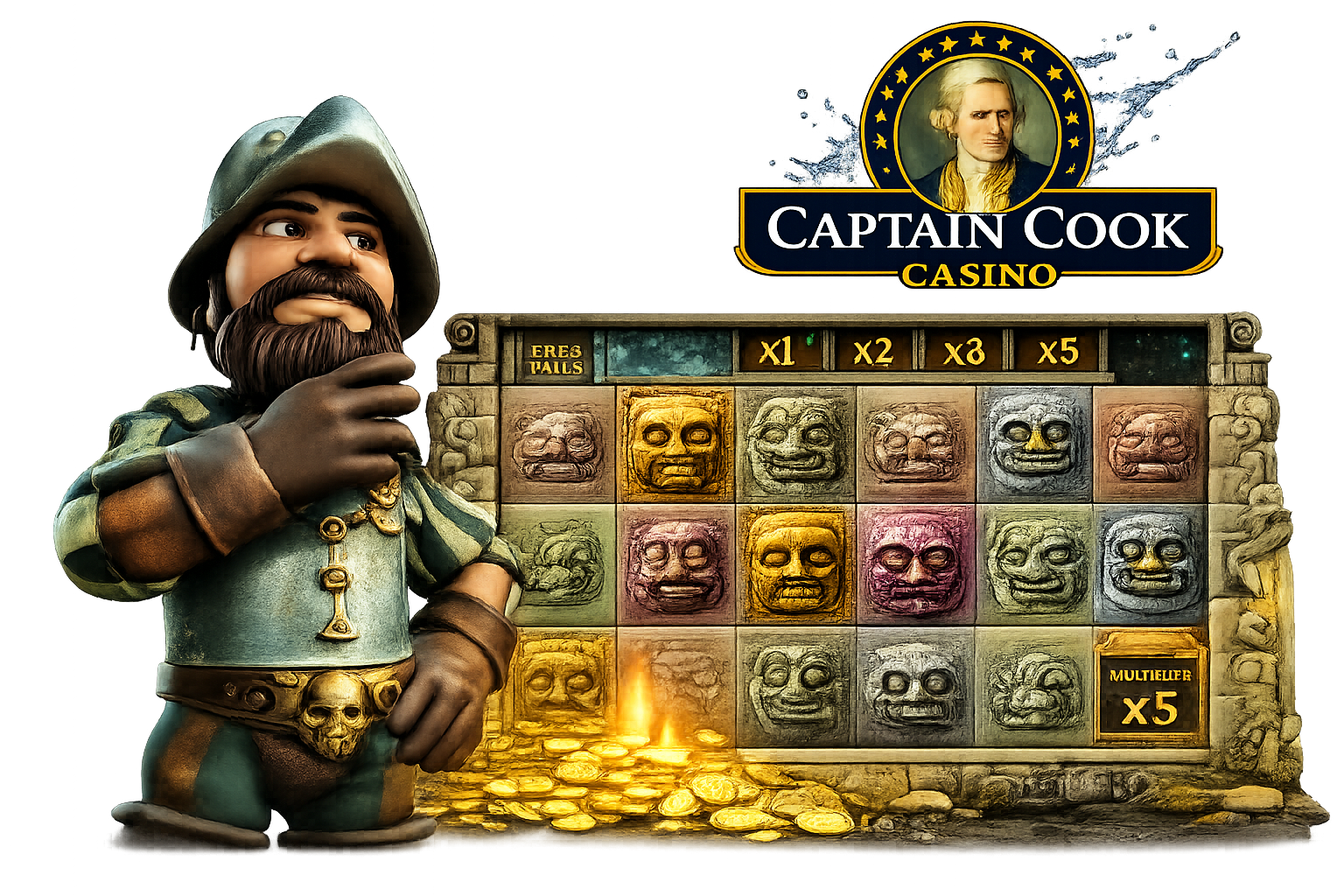
Gonzo’s Quest — core structure and interaction model
Gonzo’s Quest is built around a continuous interaction loop rather than isolated spins. The key mechanic is Avalanche: symbols disappear after a win and are replaced within the same spin, allowing sequences to develop without resetting immediately.
This shifts the way sessions behave.
Instead of discrete outcomes, the player sees short chains of events. Some spins resolve quickly. Others extend into multi-step cascades, where intensity builds inside a single cycle rather than across multiple spins.
There is no separate feature layer. Everything happens inside the base loop.
RTP as a long-term model
RTP in Gonzo’s Quest describes a statistical return over a very large number of spins.
It does not describe:
- a single session
- a short sequence
- or a temporary pattern
Because of the Avalanche structure, part of RTP distribution is tied to multiplier progression within cascades. That means outcomes are unevenly expressed across sessions.
A short session may not reflect the theoretical model at all.
RNG behaviour and outcome independence
The RNG operates independently on every spin.
There is:
- no memory
- no adjustment based on previous outcomes
- no compensation logic
Cascades are not new random events. They are a continuation of the already determined result.
This distinction matters. What looks like a “chain” is not a sequence of new chances — it is a structured unfolding of one generated outcome.
Volatility as distribution, not intensity
Volatility in Gonzo’s Quest comes from how value is distributed across cascades.
It is not driven by:
- rare bonus triggers
- or isolated high-impact events
Instead, volatility appears in:
- how often cascades extend
- how multipliers accumulate
- how frequently sequences stop early
Most sessions remain relatively stable. Some develop short intensity spikes when multipliers align with longer avalanche chains.
Core mechanic — Avalanche and multiplier growth
Each winning cascade increases the multiplier within the same spin.
Multiplier progression:
- Base game: 1x → 2x → 3x → 5x
- Free spins (if triggered): higher scaling
The important detail is structure, not magnitude.
The multiplier does not persist between spins. It resets after each completed cycle. This keeps the system bounded and prevents long accumulation across sessions.
Feature structure — no separate bonus environment
Gonzo’s Quest does not rely on a detached bonus layer.
Instead:
- base game contains the full mechanic
- cascades create internal variation
- free spins extend the same logic, not replace it
This creates consistency in interaction.
There is no hard transition from “base” to “feature-driven volatility”. The system remains continuous.
Session behaviour — rhythm and pacing
Sessions tend to follow a recognizable rhythm:
- entry → short cascades
- stabilization → repeated base hits
- uplift → multiplier chain
- settle → reset
There are no abrupt spikes driven by external triggers.
Intensity builds locally and resolves quickly. This makes the session feel controlled, even when outcomes vary.
Analytical mechanics table
Gonzo’s Quest — cascade flow and session shape
Gonzo’s Quest is easier to understand when the session is treated as a chain rather than a set of isolated results. The slot does not build pressure through a separate bonus architecture. It builds pressure inside the same cycle through symbol removal, replacement, and multiplier escalation.
That changes the reading of momentum.
A standard reel game usually resolves in one clean step. Gonzo’s Quest can remain active inside the same spin because each successful avalanche keeps the state open for one more development. The player is not entering a new mode. The player is still inside the same mechanical loop.
This matters for expectation setting.
The slot can feel more dynamic than a static-line format because movement continues after the first successful event. At the same time, this should not be mistaken for “improving odds” inside the session. The rhythm changes. The mathematical independence of each new spin does not.
Cascades create internal pacing
The Avalanche mechanic is the centre of the experience.
When a winning combination lands, those symbols disappear and new ones drop into the grid. If another win forms, the chain continues. If not, the cycle ends and the next spin begins from a reset state.
This creates a session profile with short internal waves:
- entry
- early contact
- continuation
- uplift
- reset
The important point is that the uplift is local.
Gonzo’s Quest does not accumulate force across many spins in the way some feature-led slots appear to do. It concentrates interaction inside single resolved sequences. That makes the slot feel active without requiring a separate bonus-first identity.
Multiplier logic and contained intensity
The multiplier is what gives the cascade chain its qualitative shape.
In the base game, multiplier growth remains attached to consecutive avalanche wins inside one spin. When the chain stops, the multiplier disappears with it. This creates contained bursts of intensity instead of broad session carryover.
That containment is important from an operator-side explanation perspective.
The slot can produce moments of heightened engagement, but those moments are bounded. They are not evidence of a session “warming up”, and they do not imply a compensatory pattern. They are part of a predefined interaction structure that resets naturally.
This is why Gonzo’s Quest often feels animated without becoming mechanically chaotic.
No predictive reading inside a short session
A graph for Gonzo’s Quest should describe session shape, not outcome expectation.
That means:
- no profit language
- no performance framing
- no suggestion of trend forecasting
What can be shown is the pattern of interaction density across a typical loop. In Gonzo’s Quest, that pattern usually begins with a stable entry state, rises during successful cascades, peaks when multiplier-supported chains extend, and settles once the sequence ends.
This is a UX map, not a result map.
It explains why the slot feels fluid on both desktop and mobile without making any claim about what a player should expect to receive from a short run.
Session continuity across devices
This structure translates well to mobile because the game’s visual logic is easy to read in compressed space.
There is no overloaded feature stack competing for attention. The player mainly tracks:
- symbol drop
- avalanche continuation
- multiplier step
- reset point
That produces cleaner continuity on smaller screens.
On desktop, the same logic appears more spatially open, but the underlying rhythm does not change. The slot still relies on short chained bursts followed by immediate normalization. In both environments, the mechanic remains readable because the structure is sequential and visible.
Gonzo’s Quest — continuous session structure
Gonzo’s Quest — continuous session structure
This qualitative model shows how Gonzo’s Quest tends to distribute interaction across a session: a stable entry layer, local uplift through avalanche continuation, and contained peaks when multiplier-supported chains extend. It does not display return, profit, or trend.
Contained cascade logic
Gonzo’s Quest does not divide the session into a hard base mode and separate feature identity. Most of the perceived movement is created by avalanches inside one continuous loop.
Short uplift windows
Multiplier-supported chains can create local peaks, but those peaks remain bounded to the same resolved cycle and do not continue into the next spin.
No predictive claim
This graph explains session shape only. It does not forecast outcomes and it does not represent RTP in short-session form.
Mobile readability and interface continuity
Gonzo’s Quest works well on smaller screens because the main interaction model is visually direct. The player is not asked to monitor a large number of parallel systems. Most of the attention stays on one readable chain: symbol drop, avalanche continuation, multiplier change, and reset.
That matters in mobile use.
A compact screen reduces tolerance for visual clutter. Slots that depend on too many simultaneous prompts, layered meters, or dense side information often lose clarity once the viewport narrows. Gonzo’s Quest avoids much of that pressure because its core mechanic is sequential.
The player reads one event, then the next.
That creates better continuity during short mobile sessions, especially when play is interrupted by notifications, signal fluctuation, or simple breaks in attention. Re-entry is easier because the slot does not require rebuilding context around multiple stacked systems.
Short sessions and rhythm stability
Short sessions in Gonzo’s Quest usually feel structured rather than fragmented.
The reason is not lower risk. The reason is mechanical legibility.
Even when the session contains uneven value distribution, the player can still follow the format cleanly:
- win appears
- avalanche continues or stops
- multiplier rises or resets
- new spin begins
This sequence makes the game easier to parse in fast-use conditions. It does not simplify the mathematics, but it does simplify the reading of motion.
From an operator-side UX perspective, this is a useful distinction. A slot can remain mathematically variable while still being interface-stable.
Desktop spacing and visual interpretation
On desktop, Gonzo’s Quest benefits from wider visual spacing.
The extra room does not change the logic, but it improves interpretation speed. Cascades feel more spatially open. The multiplier progression is easier to track at a glance. Reset points look cleaner and more contained.
That supports the overall product feel.
The session remains the same system on both device types, yet the desktop environment gives more breathing room to the animation layer. This often makes the slot feel calmer, even though the underlying volatility profile has not changed.
In other words, wider space changes perception, not mechanics.
Continuous-play profile
Gonzo’s Quest does not usually create a stop-start session identity. It tends to hold a continuous-play shape where the player remains in the same general flow state until a cascade sequence either extends or resolves.
This is different from heavily segmented slots where the experience depends on waiting for a separate feature window.
Here, the session is carried by repeated local interaction.
That gives the slot a more even rhythm across medium-length use. The player is less reliant on a single structural break to create engagement. Instead, engagement is distributed through repeated, visible, moderate-intensity events.
Interface friction and reset logic
The reset logic is one of the cleaner parts of the game design.
When a cascade chain ends, the interaction closes clearly. There is no blurred carryover state. No hidden persistence needs to be inferred. The player sees the end of the chain and the beginning of the next spin as separate moments.
That clarity reduces friction.
It also helps mobile interpretation, where ambiguous state transitions are more likely to create confusion. Gonzo’s Quest avoids that issue by making continuation and termination visually obvious.
This keeps the environment readable even during interrupted play.
Analytical environment table
Gonzo’s Quest — position in slot portfolio
Gonzo’s Quest sits in a category where interaction is driven by structure rather than by external features. It does not rely on a heavy bonus layer to create engagement. Instead, it distributes activity across repeated internal sequences.
That places it between two typical slot profiles:
- highly feature-dependent games
- and static line-based formats
It does not behave like either.
The experience is built on continuity. The player is not waiting for a separate state to activate. The player remains inside one loop where variation comes from how cascades evolve.
Volatility vs perceived intensity
It is easy to misread Gonzo’s Quest as more volatile than it actually is.
The reason is visual.
Avalanche chains create visible movement. Multipliers increase within a single spin. When these two elements align, the slot can produce short bursts of intensity that feel stronger than their statistical weight.
But volatility is not defined by visual activity.
Volatility is about how values are distributed across many spins. In Gonzo’s Quest, that distribution remains moderate. The slot produces variation, but it does not concentrate its entire outcome structure into rare, isolated events.
This distinction matters.
A session may feel active without being structurally high-risk in the way that bonus-dependent slots often are.
RTP interpretation across sessions
RTP should be read as a long-range model only.
Gonzo’s Quest expresses part of its RTP through cascade extension and multiplier interaction. Because of that, outcomes are not evenly distributed across short sessions.
Some sessions:
- resolve quickly with minimal cascade depth
Others:
- develop longer internal chains
Neither pattern confirms or contradicts RTP.
Short sessions are fragments. RTP describes the aggregate behaviour of a very large number of those fragments combined.
Demo mode as mechanical exploration
Demo mode in Gonzo’s Quest is useful for understanding structure.
It allows the player to observe:
- how cascades extend
- how multipliers build
- where sequences typically resolve
But it does not provide predictive value.
Demo outcomes follow the same RNG principles:
- independent
- memoryless
- non-adaptive
This means demo is a tool for reading the system, not forecasting results.
Where Gonzo’s Quest fits in player choice
From a product perspective, Gonzo’s Quest works well for players who prefer:
- continuous interaction instead of waiting for features
- visible structure rather than abstract systems
- moderate variability with readable pacing
It is less aligned with players who are specifically looking for:
- large, infrequent bonus spikes
- highly segmented game modes
- strong session discontinuity
The slot is built around flow.
That flow is created by repeated, contained sequences rather than by rare structural breaks.
Final structural note — system clarity
Gonzo’s Quest is often used as a reference point because its design is easy to explain.
- one core mechanic
- one visible loop
- clear reset logic
- no hidden state
From an operator perspective, this kind of structure reduces ambiguity.
The player can see what is happening at each step. There is no need to interpret layered systems or unclear transitions. The game communicates its behaviour directly through animation and sequence.
That clarity is the main reason the slot has remained stable in positioning across different markets, including New Zealand.
It is not defined by extremes.
It is defined by consistency of interaction.